

Funnels Aren’t Email Sequences: What a Funnel Actually Is (and Why Your Business Needs One)
Funnels are one of the most talked-about tools in online business and are also one of the most misunderstood. Somewhere along the way, funnels turned into this mysterious, high-level marketing thing that only tech bros or seven-figure brands seem to understand while also reduced and over-simplified to “automated email sequences.” While email automation is often part of a funnel, it is not what a funnel actually is. That misunderstanding alone is why so many small businesses are having so many missed opportunities for lead recovery and additional revenue generation.
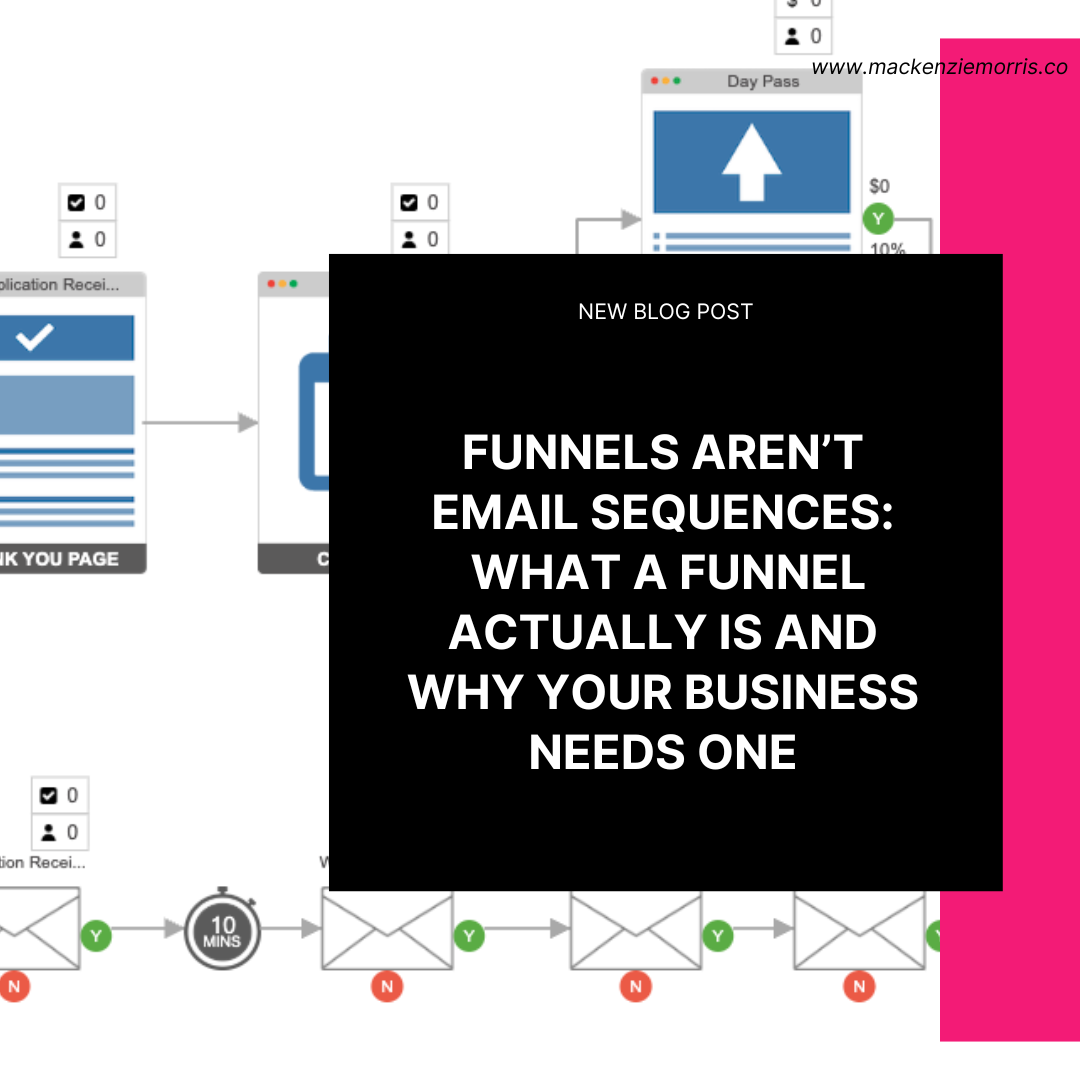
At its core, a funnel is a guided path. It is a series of intentional steps (most often web pages, sometimes paired with emails, ads, targetted messaging) that hold a customer’s hand through a specific process and lead them toward a specific outcome. That outcome might be booking a call, joining a challenge, downloading a resource, purchasing a product, or saying yes to a service. The defining feature of a funnel is not automation; it is direction.
Funnels exist because most people do not want more options. They want help deciding.
Why Most Websites Don’t Convert
The typical small business website is built with good intentions but flawed logic. It tries to show everything at once: every offer, every service, every product, every possible path. From the business owner’s perspective, this feels helpful. From the customer’s perspective, it creates decision and analysis paralysis.
People don’t land on a website thinking, “Show me everything you sell.” They land thinking, “What do I need right now and can you help me figure that out?”
This is where funnels outperform traditional websites. A website is informational. A funnel is intentional. A website assumes the visitor knows what they want. A funnel assumes they don’t and designs the experience accordingly to help them figure it out.
The Sandwich Funnel: A Simple Way to Understand Funnels
Imagine you sell sandwich supplies: bread, peanut butter, jelly, napkins, bags, utensils. Instead of listing all of these products on one page and hoping the customer figures it out, you create a funnel that walks them through the process of making a sandwich.
The funnel starts with bread. That’s the obvious first step. Once the bread is selected, the next page asks about jelly. That question only makes sense now that bread is chosen. Then peanut butter. Then storage. Do they need Ziploc bags? If not, perhaps a downsell to napkins. Then utensils. Each step is logical, sequential, and supportive.
By the time the customer reaches the end, they haven’t just shopped—they’ve been guided. They’ve made confident decisions without being overwhelmed. The funnel didn’t force anything; it clarified.
This simplified example illustrates the true purpose of funnels: helping people move forward without friction.
Funnels Are Designed for Conversion, Not Pressure
A funnel is not about tricking someone into buying something. It is about removing confusion so the right action feels obvious. Every page in a funnel has a single job. It answers one question, resolves one objection, or advances one decision.
That’s why funnels convert more effectively than open-ended websites. They reduce cognitive load. They anticipate hesitation. They give the customer just enough information to take the next step without asking them to commit to the entire journey all at once.
Funnels work because they align with human psychology, not because they’re clever or technical. If you’re having some cringey feelings about them, that’s a you problem you need to think through.
Funnels Can Lead to Many Different Outcomes
One of the most limiting myths around funnels is that they are only for selling products. In reality, funnels can be designed for nearly any business goal. The outcome of a funnel depends entirely on what you want the customer to do next.
A funnel might be built to:
capture an email address and generate a lead
book discovery calls or consultations
register people for an event, challenge, or webinar
guide visitors to the right service or offer
sell a low-ticket product
sell a physical product
warm people up for a high-ticket offer
onboard new clients
qualify leads before a sales conversation
Each of these outcomes requires a slightly different structure, but the principle remains the same: the funnel exists to guide behavior intentionally.
Funnels Are Systems, Not One-Off Pages
What makes funnels powerful is not the individual pages, but how they work together over time. A well-designed funnel becomes a system that continuously captures attention, filters interest, nurtures trust, and drives action.
Funnels can lead into other funnels. Ads can feed into funnels. Buttons on your website can route visitors into different funnels depending on their intent. Over time, you can build an entire ecosystem where each funnel supports the others and points toward your core offers.
This is how businesses stop relying on constant manual selling and start creating predictable growth.
Funnels Are Not “Set It and Forget It”
Another common misconception is that funnels are static assets. In reality, funnels are living systems that can and should evolve. A funnel that already converts can often be improved dramatically with small changes— strategic design (90% of decisions are made based on design alone - if it looks like trash you immediately lose trust), better messaging, clearer positioning, stronger offers, or more thoughtful sequencing.
Funnels can be optimized by:
refining the copy and messaging
improving design and user experience
testing different offers or entry points
adding upsells or downsells
connecting new traffic sources
building supporting funnels that feed into a main offer
At MacKenzie Morris & Associates, this is a core part of the work we do. Sometimes we build funnels from scratch. Other times, we take an existing funnel that’s already converting and help it perform better. In many cases, we build additional channels of funnels that all support a larger goal—such as a flagship offer, major event, or high-ticket service.
How Funnels Work With Ads, Email, and Social Media
Funnels don’t replace other marketing channels—they organize them. Paid ads bring attention. Funnels provide direction. Email builds relationship and trust. Social media reinforces familiarity and authority.
When these elements work together, marketing stops feeling scattered and starts feeling intentional. Funnels become the connective tissue that turns visibility into action.
The Three Funnels Most Businesses Actually Need
While funnels can be endlessly customized, most businesses don’t need dozens of them. According to industry research and platforms like ClickFunnels, the majority of businesses benefit most from having a small number of well-built funnels that do their job effectively.
Typically, these include:
a lead generation funnel that captures interest and contact information
a conversion or booking funnel that turns interest into action
a core offer or ascension funnel that leads to your primary revenue source
Everything else supports or feeds into these foundational systems.
Funnels Are About Psychology, Not Technology
Funnels are often framed as technical builds, but the real power lies in psychology. Funnels work because they respect attention spans, reduce decision fatigue, and align with how people actually think and choose.
A good funnel doesn’t feel like marketing. It feels like help.
What We Do at MacKenzie Morris & Associates
Funnels are a foundational part of the work we do at MacKenzie Morris & Associates. We don’t just build pages, we design pathways. We help businesses understand where their customers are getting stuck, confused, or overwhelmed, and then we build systems that guide them forward.
Our work includes:
funnel strategy and mapping
funnel design and development
optimization of existing funnels
integration with paid ads, email, and social strategy
expansion into multi-funnel systems
The goal is always the same: clarity, conversion, and sustainable growth.
Want to Understand Funnels A Bit Better?
If funnels still feel overwhelming or confusing, I created a free resource to help. The Sexy F*cking Funnels Hotlist breaks down the essential funnel terms you actually need to understand—without the fluff, buzzwords, or tech overwhelm.
Download the free Hotlist here:
And if you want to explore what funnels could look like specifically for your business—where you’re falling short, what’s working, and where money is being left on the table—you can book a free strategy call with us.
Funnels aren’t complicated.
They’ve just been explained poorly.
Once you understand them, they change everything.
